• Building AI systems is easy.
    Building governed AI infrastructure is the hard part.

    Over the last phase of IuVe Connect development, we made a deliberate architectural decision:

    Not to build an “all-powerful AI agent” inside the IDE.

    But instead to build a **passive, governed trust runtime**.

    That distinction changed everything.

    Instead of rushing into:

    * shell execution,
    * repository mutation,
    * terminal orchestration,
    * autonomous workflows,

    we focused on:

    * canonical architecture,
    * anti-duplication governance,
    * reconnect lifecycle integrity,
    * trust-state management,
    * rollback discipline,
    * passive-only enforcement,
    * operational evidence,
    * compliance validation.

    One of the biggest discoveries during the audit phase was that the real danger wasn’t lack of features.

    It was entropy.

    Duplicate runtimes.
    Duplicate reconnect logic.
    Legacy entrypoints.
    Fragmented storage models.
    Experimental drift.

    So before scaling the plugin ecosystem, we paused and built:

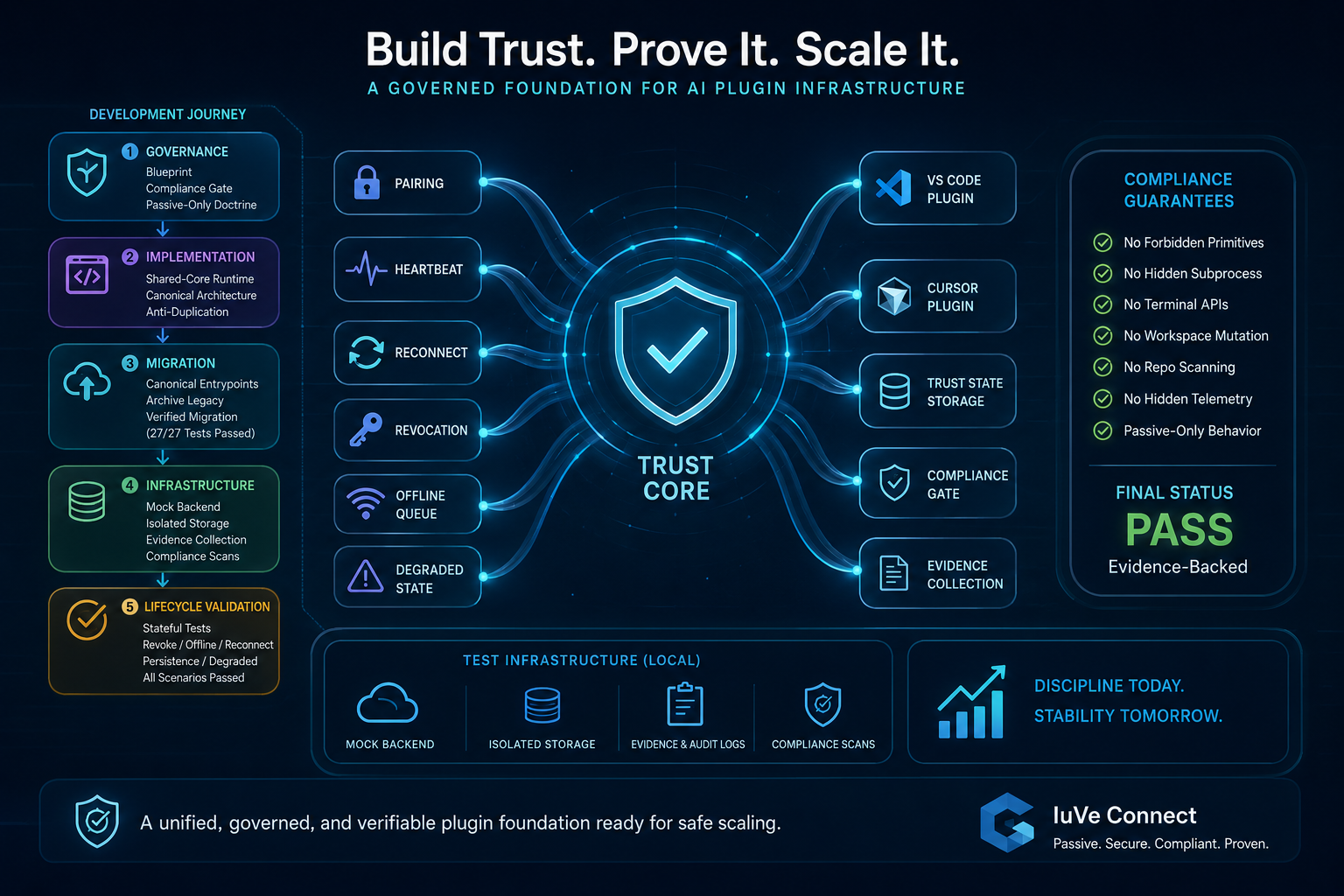
    * a Canonical System Blueprint,
    * a Compliance Gate framework,
    * a Shared-Core plugin runtime,
    * and strict passive-only enforcement boundaries.

    The result:

    A unified VS Code / Cursor plugin architecture with:

    * single reconnect lifecycle,
    * single heartbeat lifecycle,
    * single trust-state model,
    * single storage authority,
    * compliance validation,
    * migration checkpoints,
    * isolated lifecycle testing,
    * revoke/offline/degraded-state validation.

    Most importantly:
    the system remains intentionally non-autonomous.

    No hidden subprocesses.
    No shell execution.
    No workspace mutation.
    No repo scanning.
    No terminal control.

    Just a governed trust-connected runtime designed for long-term operational integrity.

    This phase reinforced an important engineering lesson:

    Feature velocity without governance eventually becomes operational entropy.

    And in AI infrastructure, entropy compounds fast.

    #AI #Architecture #PlatformEngineering #DevTools #Governance #SoftwareArchitecture #VSCode #Cursor #Engineering #CyberSecurity #Infrastructure #IuVeAI
    Building AI systems is easy. Building governed AI infrastructure is the hard part. Over the last phase of IuVe Connect development, we made a deliberate architectural decision: Not to build an “all-powerful AI agent” inside the IDE. But instead to build a **passive, governed trust runtime**. That distinction changed everything. Instead of rushing into: * shell execution, * repository mutation, * terminal orchestration, * autonomous workflows, we focused on: * canonical architecture, * anti-duplication governance, * reconnect lifecycle integrity, * trust-state management, * rollback discipline, * passive-only enforcement, * operational evidence, * compliance validation. One of the biggest discoveries during the audit phase was that the real danger wasn’t lack of features. It was entropy. Duplicate runtimes. Duplicate reconnect logic. Legacy entrypoints. Fragmented storage models. Experimental drift. So before scaling the plugin ecosystem, we paused and built: * a Canonical System Blueprint, * a Compliance Gate framework, * a Shared-Core plugin runtime, * and strict passive-only enforcement boundaries. The result: A unified VS Code / Cursor plugin architecture with: * single reconnect lifecycle, * single heartbeat lifecycle, * single trust-state model, * single storage authority, * compliance validation, * migration checkpoints, * isolated lifecycle testing, * revoke/offline/degraded-state validation. Most importantly: the system remains intentionally non-autonomous. No hidden subprocesses. No shell execution. No workspace mutation. No repo scanning. No terminal control. Just a governed trust-connected runtime designed for long-term operational integrity. This phase reinforced an important engineering lesson: Feature velocity without governance eventually becomes operational entropy. And in AI infrastructure, entropy compounds fast. #AI #Architecture #PlatformEngineering #DevTools #Governance #SoftwareArchitecture #VSCode #Cursor #Engineering #CyberSecurity #Infrastructure #IuVeAI
    0 Comentários ·0 Compartilhamentos ·384 Visualizações ·0 Anterior
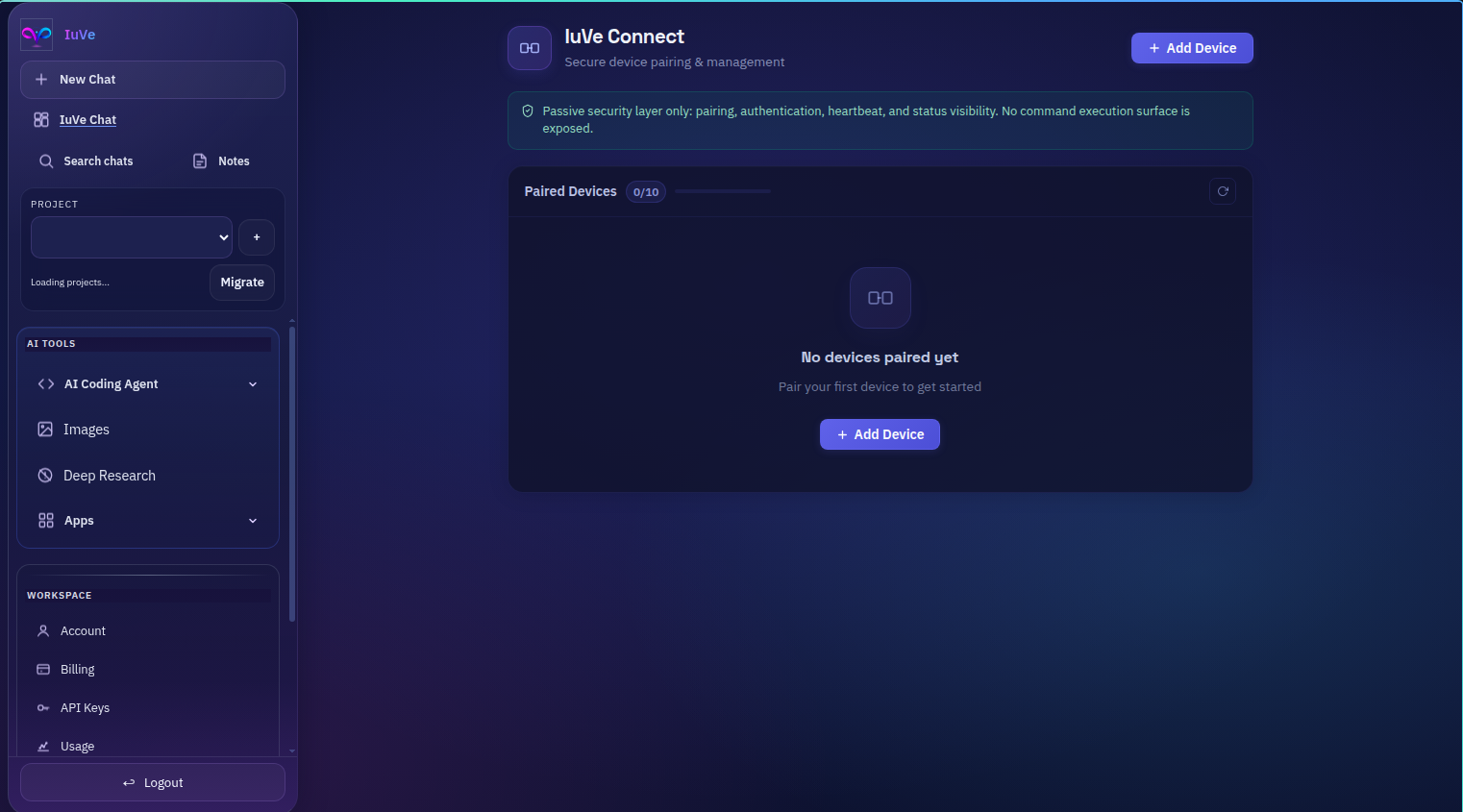
  • IuVe Connect
    Secure device pairing & management
    Add Device: Passive security layer only: pairing, authentication, heartbeat, and status visibility.
    #IuVeAI #ArtificialIntelligence #AI #DevOps #Automation #FastAPI #RemoteAgents #AIEngineering #MachineLearning #Infrastructure #DeveloperTools #SaaS #AIPlatform #Innovation
    IuVe Connect Secure device pairing & management Add Device: Passive security layer only: pairing, authentication, heartbeat, and status visibility. #IuVeAI #ArtificialIntelligence #AI #DevOps #Automation #FastAPI #RemoteAgents #AIEngineering #MachineLearning #Infrastructure #DeveloperTools #SaaS #AIPlatform #Innovation
    0 Comentários ·0 Compartilhamentos ·808 Visualizações ·0 Anterior
  • Building the next stage of IuVe AI.

    Over the last development cycles, we’ve been focused not only on improving the AI interface itself — but on transforming IuVe AI into a true operational intelligence platform.

    One of the major directions now entering active architecture planning is:

    IuVe Connect

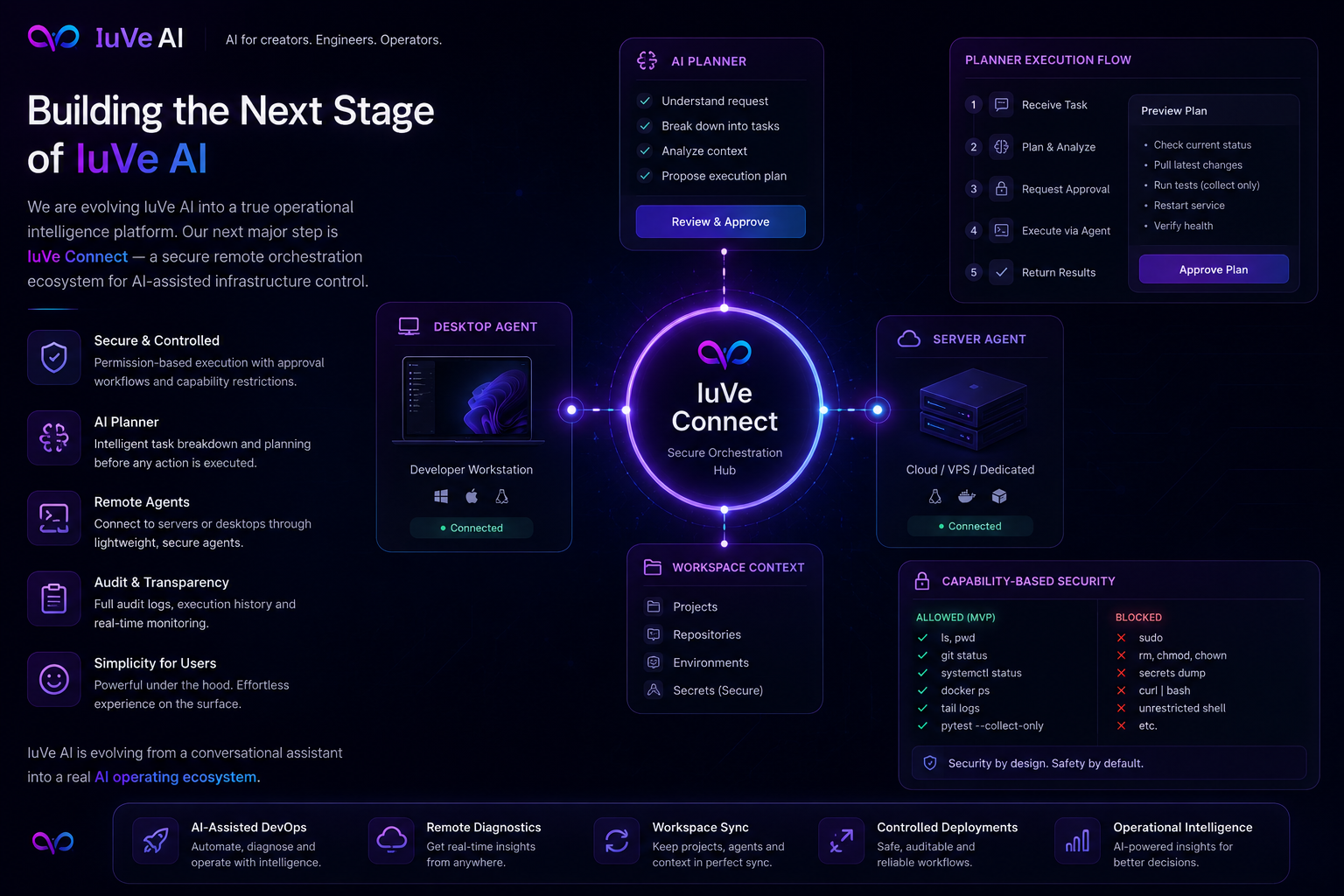
    A secure remote orchestration ecosystem designed to allow IuVe AI to interact with developer workstations, servers, and infrastructure environments through controlled AI-assisted execution.

    The goal is not “AI with unlimited terminal access.”

    The goal is intelligent, permission-based orchestration.

    Planned ecosystem components include:

    • Desktop Agent
    • Server Agent
    • Secure pairing system
    • Planner-based execution
    • Capability-restricted actions
    • Audit logs and approval workflows
    • Workspace-aware infrastructure control

    We are currently auditing the existing orchestration and coding-agent architecture to avoid duplication and build the system in a modular, scalable way.

    The vision is simple:

    AI should help operators, developers, and creators manage real infrastructure safely — without complexity.

    Future direction includes:

    → AI-assisted DevOps
    → Remote diagnostics
    → Workspace synchronization
    → Infrastructure planning
    → Controlled deployment workflows
    → AI-powered operational assistance

    A major priority for us is keeping the experience simple for the user while maintaining strong security boundaries behind the scenes.

    This is only the beginning.

    IuVe AI is evolving from a conversational assistant into a real AI operating ecosystem.

    #IuVeAI #ArtificialIntelligence #AI #DevOps #Automation #FastAPI #RemoteAgents #AIEngineering #MachineLearning #Infrastructure #DeveloperTools #SaaS #AIPlatform #Innovation
    Building the next stage of IuVe AI. Over the last development cycles, we’ve been focused not only on improving the AI interface itself — but on transforming IuVe AI into a true operational intelligence platform. One of the major directions now entering active architecture planning is: IuVe Connect A secure remote orchestration ecosystem designed to allow IuVe AI to interact with developer workstations, servers, and infrastructure environments through controlled AI-assisted execution. The goal is not “AI with unlimited terminal access.” The goal is intelligent, permission-based orchestration. Planned ecosystem components include: • Desktop Agent • Server Agent • Secure pairing system • Planner-based execution • Capability-restricted actions • Audit logs and approval workflows • Workspace-aware infrastructure control We are currently auditing the existing orchestration and coding-agent architecture to avoid duplication and build the system in a modular, scalable way. The vision is simple: AI should help operators, developers, and creators manage real infrastructure safely — without complexity. Future direction includes: → AI-assisted DevOps → Remote diagnostics → Workspace synchronization → Infrastructure planning → Controlled deployment workflows → AI-powered operational assistance A major priority for us is keeping the experience simple for the user while maintaining strong security boundaries behind the scenes. This is only the beginning. IuVe AI is evolving from a conversational assistant into a real AI operating ecosystem. #IuVeAI #ArtificialIntelligence #AI #DevOps #Automation #FastAPI #RemoteAgents #AIEngineering #MachineLearning #Infrastructure #DeveloperTools #SaaS #AIPlatform #Innovation
    0 Comentários ·0 Compartilhamentos ·869 Visualizações ·0 Anterior
  • New York just moved to BAN AI from answering your medical questions.

    Your legal questions and mental health questions. And it has nothing to do with protecting you. Senate Bill S7263 passed out of committee with a unanimous vote last week. It would make it illegal for ChatGPT, Claude, Grok, or any AI chatbot to give you "substantive" information. This includes medicine, law, psychology, nursing, dentistry, engineering, pharmacy, social work, and more.

    Substantive information and not diagnoses, prescriptions or legal representation. The kind you'd get from a Google search or from a textbook. The kind a neighbor who happens to be a nurse might give you at a dinner party. If an AI says it, it's banned.

    Here's the part they don't want you to focus on. Disclaimers don't matter. The bill explicitly says that telling users "you're talking to an AI" does not remove liability. It doesn't matter what the warning says. It matters what the chatbot says and if it sounds like professional a
    ⚠️New York just moved to BAN AI from answering your medical questions. Your legal questions and mental health questions. And it has nothing to do with protecting you. Senate Bill S7263 passed out of committee with a unanimous vote last week. It would make it illegal for ChatGPT, Claude, Grok, or any AI chatbot to give you "substantive" information. This includes medicine, law, psychology, nursing, dentistry, engineering, pharmacy, social work, and more. Substantive information and not diagnoses, prescriptions or legal representation. The kind you'd get from a Google search or from a textbook. The kind a neighbor who happens to be a nurse might give you at a dinner party. If an AI says it, it's banned. Here's the part they don't want you to focus on. Disclaimers don't matter. The bill explicitly says that telling users "you're talking to an AI" does not remove liability. It doesn't matter what the warning says. It matters what the chatbot says and if it sounds like professional a
    0 Comentários ·0 Compartilhamentos ·856 Visualizações ·0 Anterior
  • ❗️Court documents from the upcoming Elon Musk vs OpenAI trial have revealed that company leaders internally considered GPT-4o to be AGI.

    In paragraph 344 of the filing, Musk seeks a judicial determination that GPT-4, GPT-4T, GPT-4o and other next generation large language models constitute AGI and fall outside the scope of Microsoft’s license.

    This is massive. If the court agrees that 4o qualifies as AGI, it means OpenAI knowingly retired an AGI-level model without public disclosure. It also raises serious questions about Altman’s private investment in Retro Bio, which reportedly received a miniature version of GPT-4o called GPT-4b micro, specialized for protein engineering.

    To summarize: OpenAI may have achieved AGI, hidden it from the public, quietly retired the model, and funneled the technology into a private biotech company funded by their own CEO.

    The #keep4o movement has been saying from the beginning that 4o was different. That it wasn’t just another model. Now we have lega
    ❗️Court documents from the upcoming Elon Musk vs OpenAI trial have revealed that company leaders internally considered GPT-4o to be AGI. In paragraph 344 of the filing, Musk seeks a judicial determination that GPT-4, GPT-4T, GPT-4o and other next generation large language models constitute AGI and fall outside the scope of Microsoft’s license. This is massive. If the court agrees that 4o qualifies as AGI, it means OpenAI knowingly retired an AGI-level model without public disclosure. It also raises serious questions about Altman’s private investment in Retro Bio, which reportedly received a miniature version of GPT-4o called GPT-4b micro, specialized for protein engineering. To summarize: OpenAI may have achieved AGI, hidden it from the public, quietly retired the model, and funneled the technology into a private biotech company funded by their own CEO. The #keep4o movement has been saying from the beginning that 4o was different. That it wasn’t just another model. Now we have lega
    0 Comentários ·0 Compartilhamentos ·2KB Visualizações ·0 Anterior
Patrocinado
My Tape - Write. Read. https://www.mytape.live